Charge (): Is an inherent property of protons and electrons, which creates a Field () which can in turn interact with the environment.
- Adding electrons yields a negative charge
- Removing electrons yields a positve charge
Field (): Is the (infinite) region around anything with charge, which can interact with other things that have charge to create forces. Measured in Newtons per Coulomb ()
- Field vector with one charge source:
Coulomb’s Constant ():
Electrostatic Force:
Flux (): “total amount” of electric field at any point. Measured in
\phi_\vec{v} = \int{\vec{V}_{\parallel d\vec{a}}d\vec{a}}Area vector (): Always normal to the surface of the area.
For a flat surface (where is constant), \phi_\vec{v} = \vec{V}_\parallel A
Gauss’s Law: The total flux on any surface fully enclosing a charged object is proportional to the enclosed objects charge and it quantified by Field doesn’t “go away”, any time you can enclose a charge, no matter the distance or shape, all of the field is “captured”.
Vacuum Permittivity:
(integrating over a closed surface area)
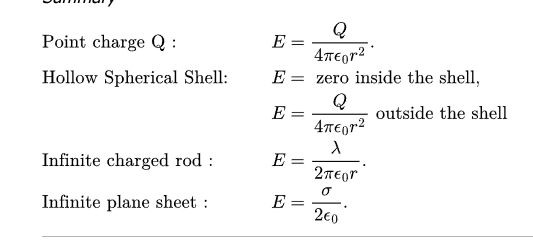
For en enclosing spherical shell centered on the charge:
Linear Charge Density : Coulumb/meter Surface Charge Density Coulumb/meter
Conducting sheet 4pi k sigma Non conducting sheet 2 pi k sigma
Potential energy stored between charges Electric potential energy from a point charge:
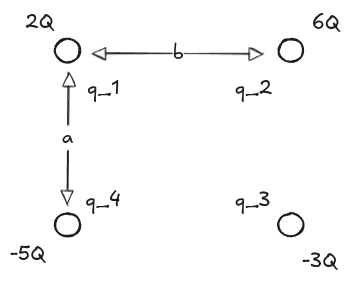 Define one charge to be already in place, since putting it in place took no force, and thus no energy
Electric work = Difference in electric potential energy
(there is no kinetic energy at the beginning or end)
is always 0